
From drawing review and process planning to inspection records and delivery milestones
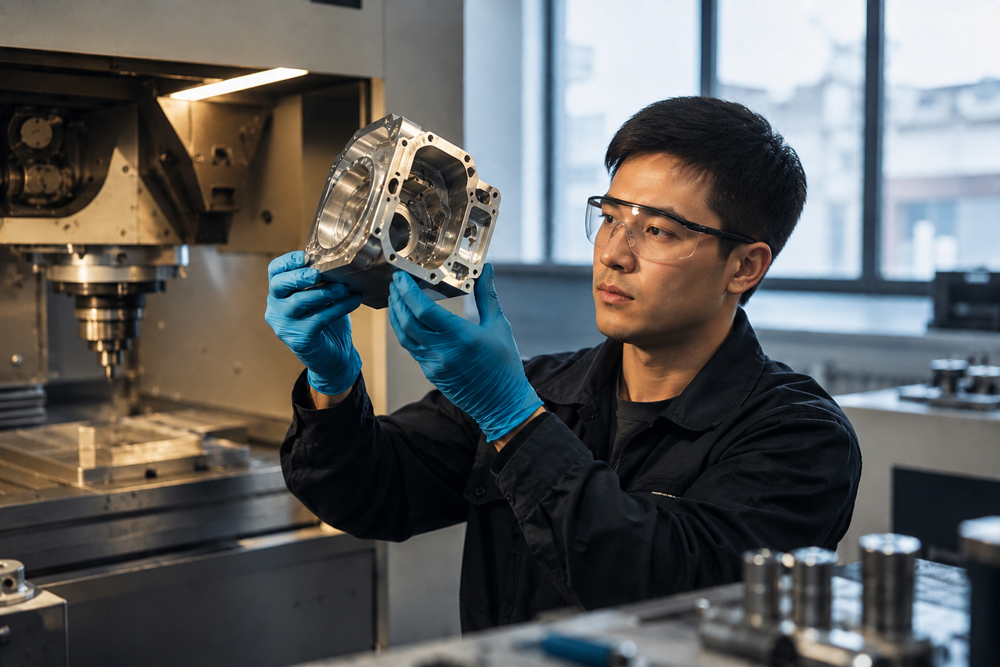
CNC engineer reviewing a machined component
For an overseas procurement team, the hardest part of sourcing custom CNC parts is not finding a supplier that can produce one sample. The real challenge is determining whether that supplier can deliver the same result repeatedly, document the process clearly, and respond quickly when something changes.
A drawing can be quoted. A prototype can be made. But the success of a custom machining project is usually decided later, when the order moves into production and the buyer has to manage batch consistency, lead time, inspection records, import documents, and communication across time zones.
That is why unit price should be only one part of the decision. The more important question is whether the supplier can identify manufacturing risks before production and convert uncertainty into a process that can be reviewed and verified.
Many drawings are functionally correct but do not fully consider the realities of machining. Typical risk points include:
If these issues are discovered only after the first part is completed, the project can quickly turn into repeated revisions, re-quoting, and delayed delivery.
Two quotations may both describe a product as an “aluminum CNC part” or a “custom metal component,” while covering very different materials, processes, and inspection requirements.
The price difference may come from:
When a buyer compares only the unit price, different scopes can easily be mistaken for different supplier efficiency.
A prototype is often handled closely by an engineer. Mass production depends much more on a stable process, repeatable fixturing, and a clearly defined inspection plan.
Common issues include inconsistent fit, shifted hole positions, surface-treatment thickness affecting assembly, or threads and chamfers that do not match the mating component.
For parts used in automation equipment, industrial enclosures, fixtures, or finished products, the cost of a nonconforming part is not limited to the part itself. It can also include rework, replacement shipping, assembly downtime, and delayed delivery to the end customer.

A production line being monitored in an industrial facility
4. The lead time is written on the quotation, but there are no visible milestones
“15–20 days” is not the same as a manageable production plan. A procurement team needs to know when drawing conversion will be finished, when the material will be confirmed, when the first article will be checked, how long finishing will take, and when final inspection and packing will be completed.
A lead time without milestones can only be managed by repeated follow-up. A milestone-based plan makes it possible to identify risk before the promised delivery date is reached.
Depending on the buyer’s market and internal approval process, the project may require material certificates, dimensional inspection records, surface-treatment information, origin documents, or compliance declarations.
If these requirements are not confirmed at the start, documents may have to be prepared urgently before shipment. That can create avoidable delays during internal acceptance or import clearance.
A well-managed custom machining project should not begin with “Please quote.” It should begin with “Can this part be manufactured consistently under the required conditions?”
A DFM (Design for Manufacturing) review is not intended to redesign the buyer’s product. Its purpose is to identify which design features may affect cost, lead time, or repeatability.
A practical DFM review may cover:

A useful DFM review does not simply say “possible” or “not possible.” It connects each recommendation to its functional impact, cost impact, and manufacturing risk, so the procurement and engineering teams can make an informed decision together.
Before comparing prices, ask suppliers to state the following items clearly:
Item |
What should be confirmed |
Material |
Exact grade, condition, and whether a material certificate is available |
Blank |
Plate, bar, extrusion, tube, casting, or another form |
Process |
CNC milling, turning, mill-turn, drilling, tapping, heat treatment, and finishing scope |
Quality |
Critical dimensions, inspection ratio, and measurement method |
Documents |
FAI, CMM, MTC, RoHS, or other project-specific documents |
Lead time |
Prototype, production, finishing, and shipping timelines |
Packaging |
Protection against scratches, moisture, impact, and part-to-part contact |
Once the scope is visible, the buyer is no longer comparing a single number. The buyer is comparing a defined delivery package and its total project risk.
Step 3: Use first-article inspection to control production risk
First-article inspection should not be treated as “making one sample to see how it looks.” It is a verification of the process that will be used for production.
At this stage, the buyer and supplier should confirm:
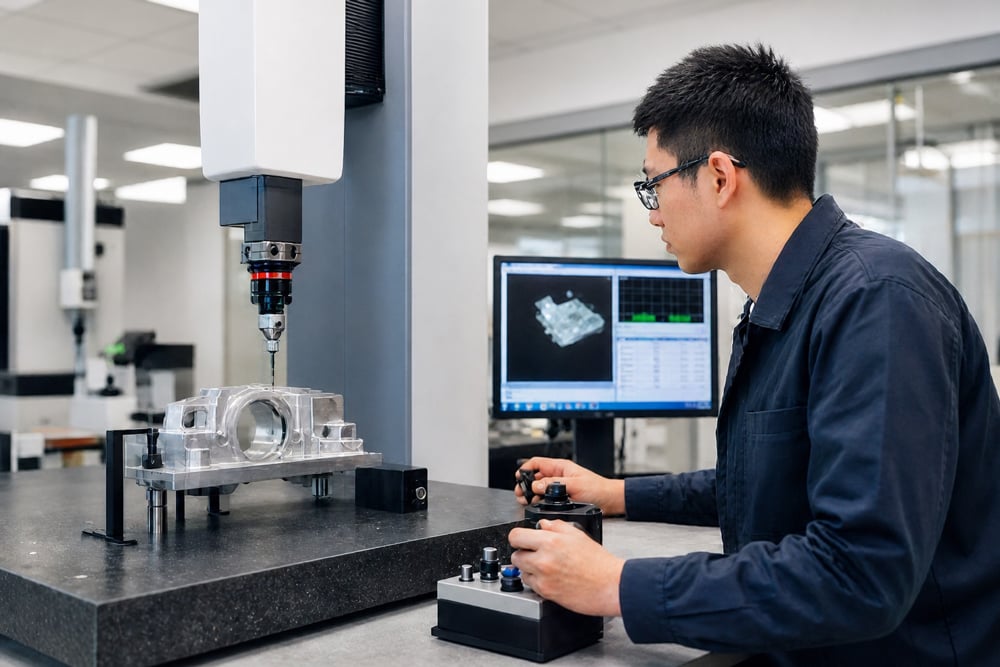
CMM inspection of a machined component
If the first article reveals a problem, the priority should be to correct the process route rather than select one visually acceptable piece and move directly into mass production.
For an international project, production can be divided into checkpoints such as:
Each checkpoint should have a defined deliverable, such as an approved shop drawing, material evidence, first-article measurement results, production photos, or a final inspection record. This gives the buyer something concrete to review instead of asking for a general status update.
A short project specification summary can reduce confusion between emails, drawings, and chat messages. It should include:
The purpose is not to create more paperwork. It is to give engineering, production, quality, and procurement teams one version of the requirements to work from.
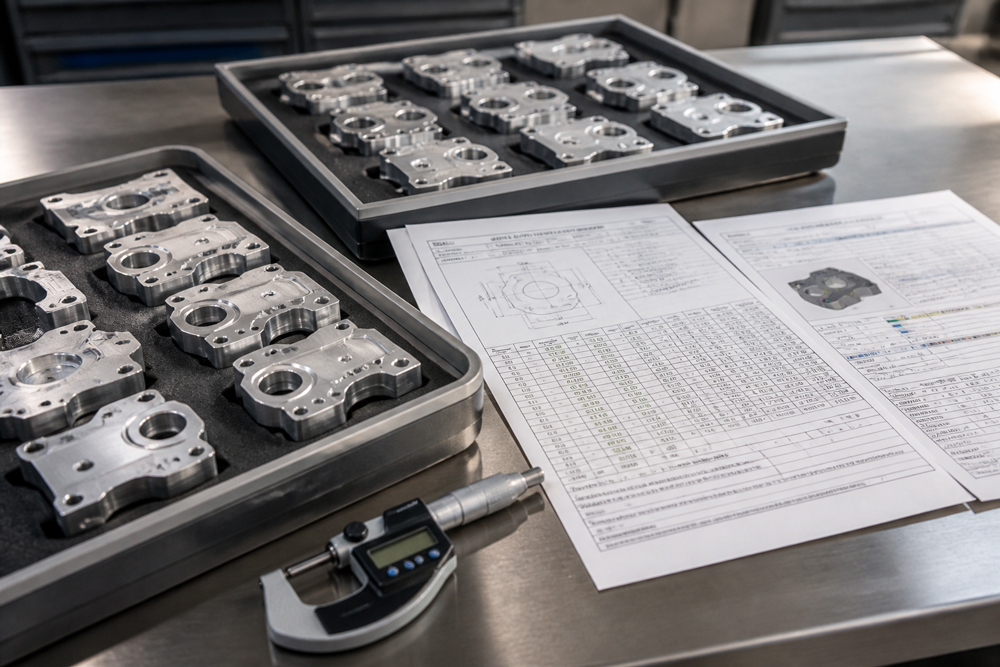
Machined parts packed with inspection records
Equipment lists and factory photographs can provide context, but they do not answer every procurement question. Pay attention to how the supplier handles details:
A mature supplier does not promise that every project is “no problem” before the design, material, and acceptance criteria are confirmed. The more reliable approach is to identify the risk, explain the available solution, and then issue a quotation and lead time based on the confirmed scope.
For an overseas buyer, the ideal supplier is not necessarily the one with the lowest quotation. It is the supplier that helps the project avoid preventable mistakes.
A well-managed collaboration should help the procurement team answer five questions with confidence:
When these questions can be answered through a defined process and usable records, the buying decision no longer depends on trusting a sales promise alone. It is based on a delivery system that can be reviewed, verified, and traced.
If you are evaluating a CNC part, metal enclosure, or automation equipment component, starting with a drawing review is often more effective than simply searching for the lowest price. Identify the manufacturing risks first, then compare quotations against the same technical and delivery requirements.

Engineer reviewing a customer drawing before quotation
Have a drawing under review? Start with the manufacturability questions before the price discussion.

Copyright © 2024 by Xiamen Tongchengjianhui Industry & Trade Co., Ltd. - Privacy policy
