
If you buy brass components, 2026 has probably felt less like a purchasing year and more like a hedging exercise. Quotes that were valid for a quarter now need revisiting in weeks. Mills issue alloy surcharges with short notice. And the explanation you get — "copper is up" — does not tell you whether to lock a price, re-design the part, or simply wait.
This is a short, factual breakdown of what actually happened to brass raw material costs in 2026, the forces behind it, and the practical steps buyers are taking to keep part pricing predictable..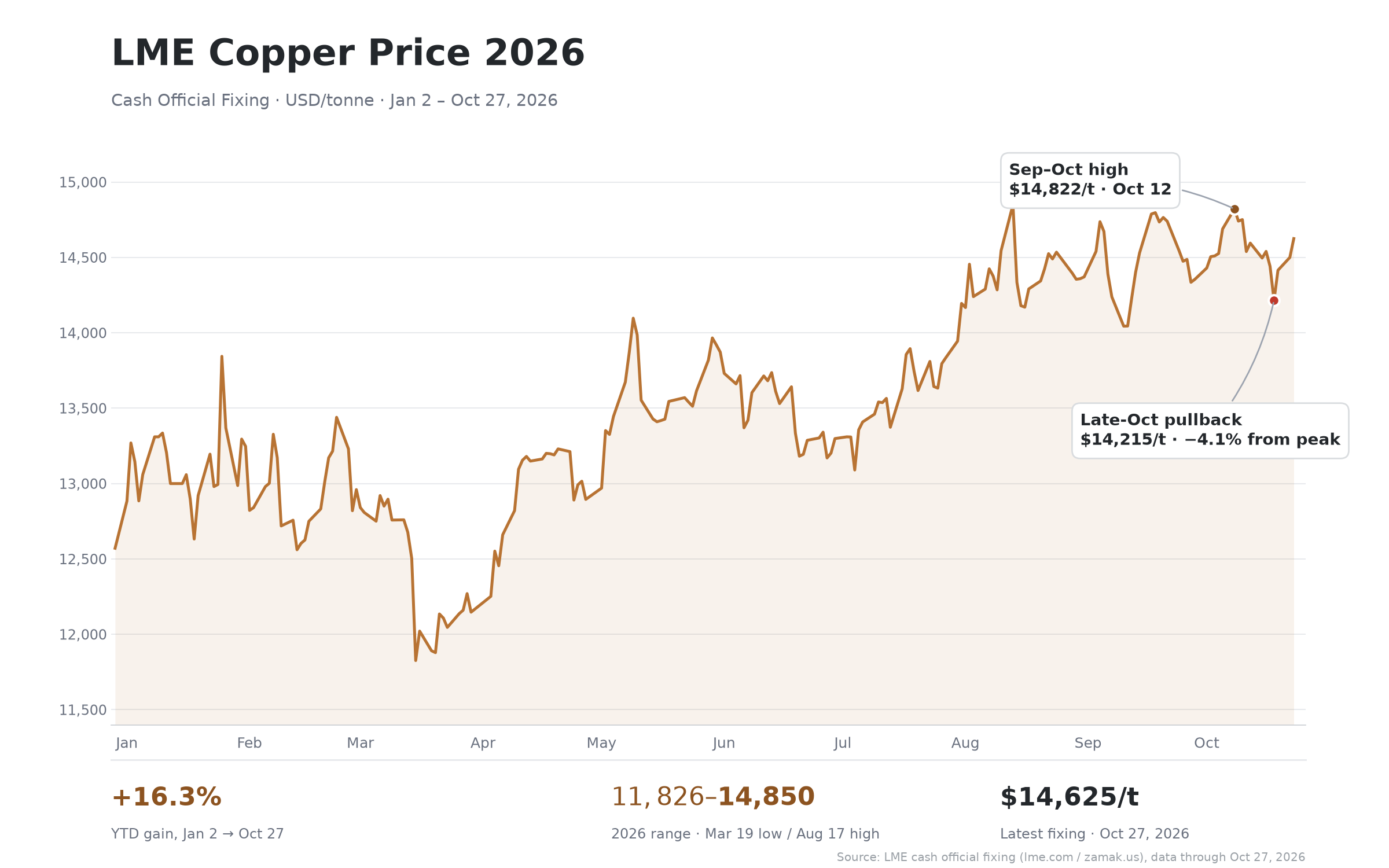
What actually moved
Brass is a copper-zinc alloy, and copper is its reference price — so the story starts there.
LME three-month copper set successive record highs during 2026, peaking intraday at $14,875 per tonne on 10 September (Fastmarkets, October 2026). The 2026 average stood at $13,395 per tonne, roughly 35% above the 2025 average, according to International Copper Study Group data reported by S&P Global in October 2026. Through late October, copper was still trading near record highs above $14,000 per tonne (Reuters, 26 October 2026).
Zinc, the smaller half of the alloy, moved too, but on a different pattern. LME zinc traded in a band of roughly $3,770–3,980 per tonne from late September into early October 2026, and the physical market tightened: the zinc SHG ingot premium delivered Rotterdam rose to $330 per tonne on 13 October, from $217.50 earlier in the period (Fastmarkets).
The important detail is that none of this was a straight line. In the third week of October, copper dropped to a five-week low as a selloff in AI-linked technology stocks hit sentiment across industrial metals. Within days it was recovering. That jaggedness — not the direction — is what has made 2026 difficult to plan around.
The four forces behind the swings
1.Mine supply fell short, and smelters are paying for itGlobal copper mine output declined, and the clearest symptom is in treatment charges — the fee smelters earn for processing concentrate. Those charges hit record lows in 2026 (Fastmarkets, October 2026). When TCs collapse, it means smelters are competing for concentrate that is not there. Refined metal then tightens a step behind the ore.
This is not a short-cycle problem. A new copper mine takes the better part of a decade from discovery to first production, so a supply gap that opens in 2026 does not close in 2027.
2. Policy, not geology, fragmented the price
The prospect of US tariffs on copper under Section 232 pulled metal toward the American market and widened regional premiums, effectively splitting one global price into several local ones. Reuters' LME Week commentary in October 2026 described copper supply as "fragmented by government policy" — an accurate summary of the year.
For a buyer in Europe or Asia, this matters because the LME number on a screen is no longer the number you pay. Physical premium, freight and regional availability now move independently of it.
3. Demand became structural rather than cyclical
Grid investment, electrification, EVs, data centres and the power infrastructure behind AI compute all consume copper in volumes that construction and appliance demand never did. S&P Global's LME Week analysis in October 2026 framed the market simply: supply is struggling to keep pace with electrification demand.
That changes the nature of a price spike. Traditional cycles end when housing or autos slow. This demand base is contracted years ahead, so it responds slowly to price.
4. The second cost leg: zinc, energy and freight
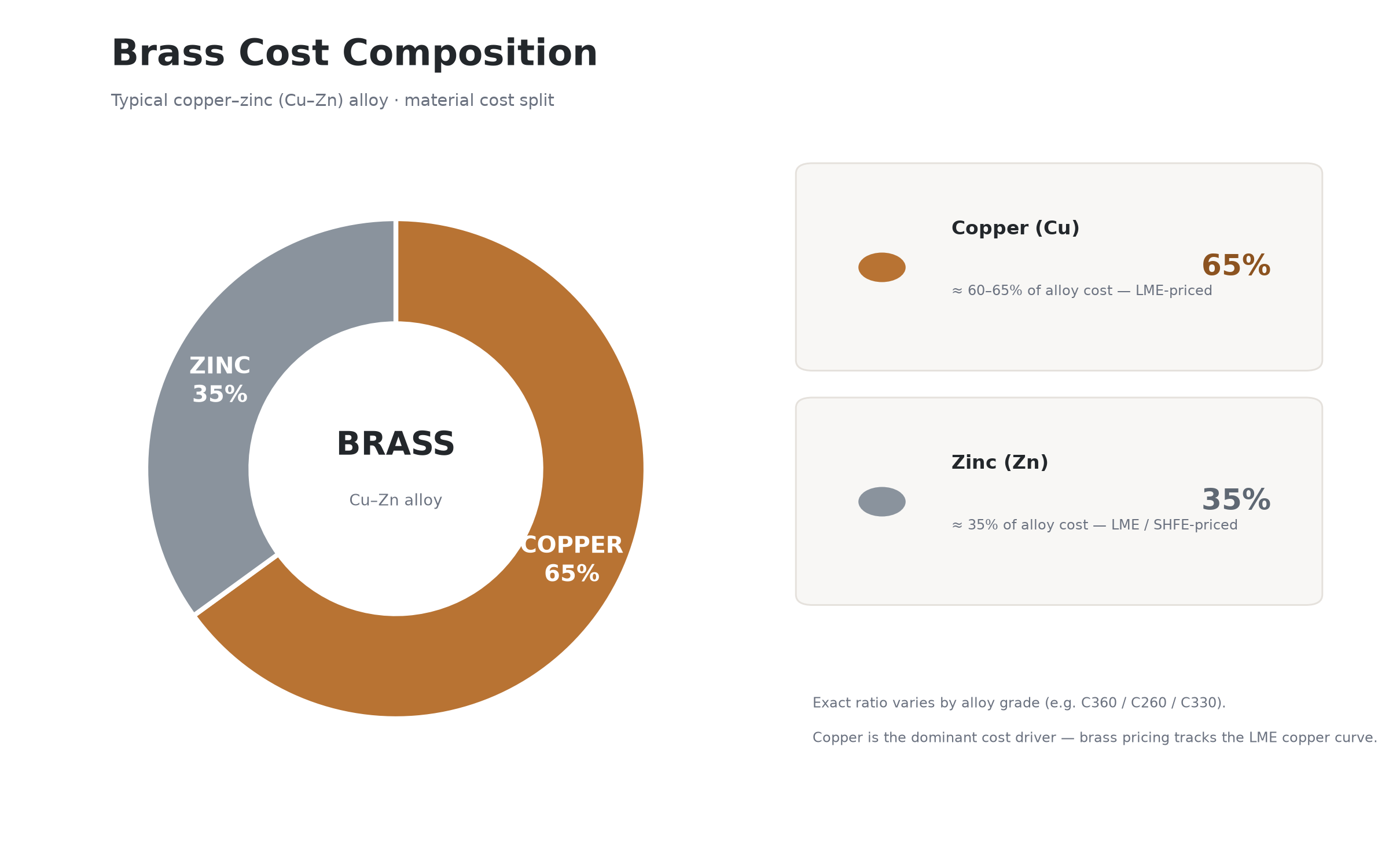
Brass is roughly 60–65% copper and 35% zinc by weight. Zinc has been less dramatic than copper but not stable, and the Rotterdam premium increase shows the physical market tightening independently of the LME quote. Add energy costs for melting and drawing, plus container freight, and a brass mill's cost base has three moving parts — not one.
5. Sentiment now moves metal faster than orders do
The October pullback is the cleanest illustration. Nothing changed in mine supply or Chinese fabrication demand that week; a technology-stock selloff changed the mood, and copper fell to a five-week low before recovering. Financial positioning can move the price several percent inside a week, which is why quoting brass parts on dated assumptions is risky in both directions.
Why brass hurts more than steel
Three structural reasons:
High metal share of part cost. In a small turned or stamped brass component, material can be 50–70% of the unit price. In a steel sheet metal assembly it is often 25–40%. The same copper move therefore lands much harder.
Surcharge mechanics. Brass mills quote LME plus premium plus conversion, revised monthly or quarterly. That structure passes volatility straight through the supply chain rather than absorbing it.
Scrap credit depends on discipline. Clean, segregated brass turnings retain real value; mixed or contaminated scrap does not. A shop that segregates properly can return meaningful credit to the part price — one that does not, quietly loses it.
What buyers are doing about it
The purchasing response in 2026 has converged on a few practical measures:
1.Quote on a metal basis, not a single number. A well-drafted clause references a named index (LME copper average of a stated month) plus a fixed conversion charge. Both sides then know exactly what moves and by how much.
2.Set a realistic validity window. Fifteen to thirty days is fair in this market; a six-month fixed price on a copper-intensive part is either a hidden risk premium or a mistake.
3.Design material out where it is free to do so. For a stamping part, strip layout and nesting decide how much brass ends up as skeleton scrap — a DFM review before tooling release often recovers several percent of material with no functional change. In machining, the equivalent levers are stock allowance and near-net input.
4.Ask for scrap credit, itemised. If your part generates brass scrap, it should appear as a line, not disappear into a rate.
5.Revisit the alloy, with eyes open. Lead-free and alternative copper alloys exist, but they machine differently and can cost more in cycle time than they save in metal. Test before switching, and check that the substitute still meets the drawing's conductivity, corrosion and machinability requirements.
6.Consolidate and schedule. Fewer suppliers with larger, more predictable releases get better metal allocation than spot buyers, particularly when premiums are widening.
How we handle brass pricing
How we handle brass pricing
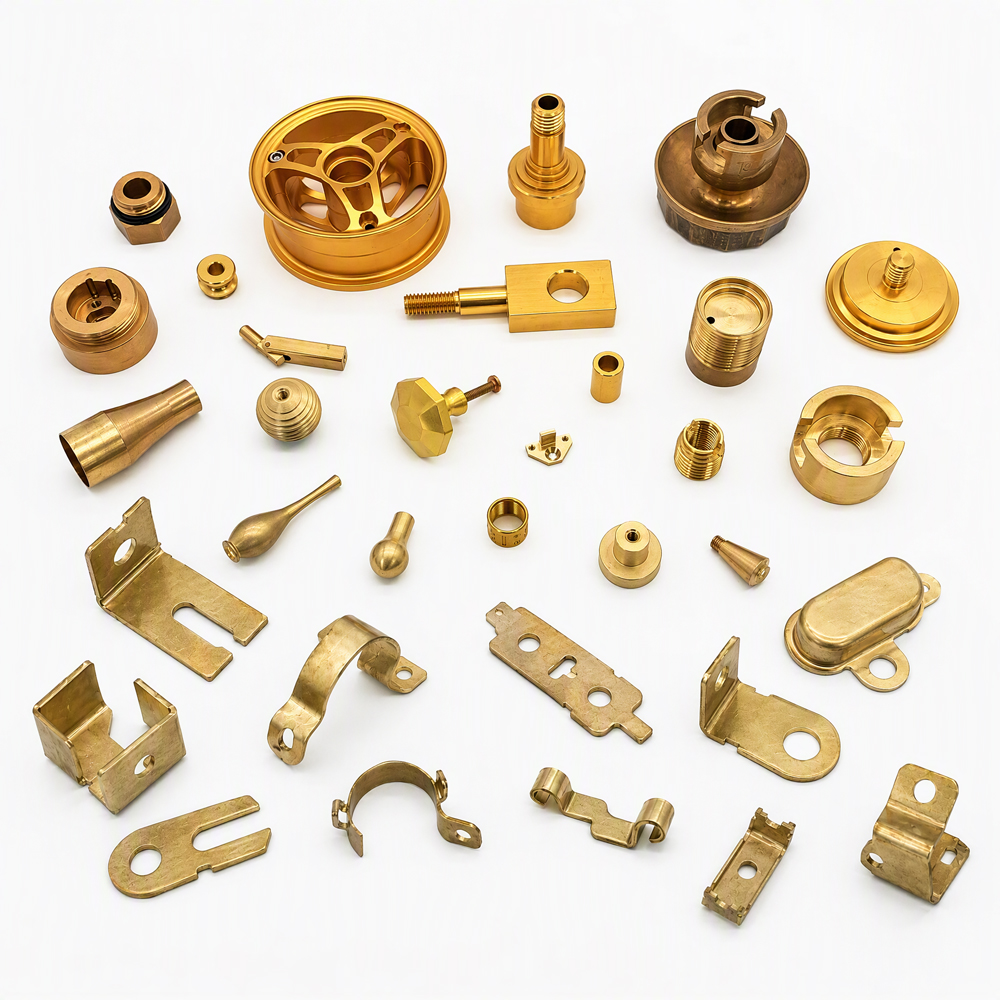
At Xiamen Tongchengjianhui, brass appears across three production lines: progressive-die and compound-die stamping, turning and milling, and light sheet metal work. When we quote a CNC machined service job or a brass stamping part, we show the metal content and the conversion separately rather than burying the alloy price in a single rate. If copper moves, you can see the effect on your cost without renegotiating the whole quotation — and you can see when it moves in your favour.
We also run strip-layout and DFM reviews before tooling is cut. It is the cheapest way to take material out of a part, and it is work that has to happen before a die exists, not after.
If your program also includes steel or aluminium enclosures, our sheet metal fabrication service follows the same principle: material basis stated, conversion stated, scrap accounted for.
The outlook: plan for volatility, not direction
Nothing in the current data suggests a quick return to calm. Record-low treatment charges point to continued concentrate tightness; new mine supply is years away; electrification demand is contracted rather than discretionary; and tariff policy remains an active variable that can reprice a region in weeks.
The reasonable planning assumption for the next two to three quarters is not "prices will rise" or "prices will fall" but double-digit percentage swings within a single quarter. Contracts written with an index clause survive that. Contracts written on a single fixed number do not — whichever direction the market goes.
Sourcing brass or copper alloy components and want a cost structure you can actually audit? Send your drawing, annual volume and current price breakdown for a DFM and material review — we will show you where the metal content sits and where the scrap is going.

Copyright © 2024 by Xiamen Tongchengjianhui Industry & Trade Co., Ltd. - Privacy policy
