
A PCB bracket nearly ruined a $550,000 order - when precision components became the "last line of defense" for high-end projectors
A real case study with a Western brand direct client
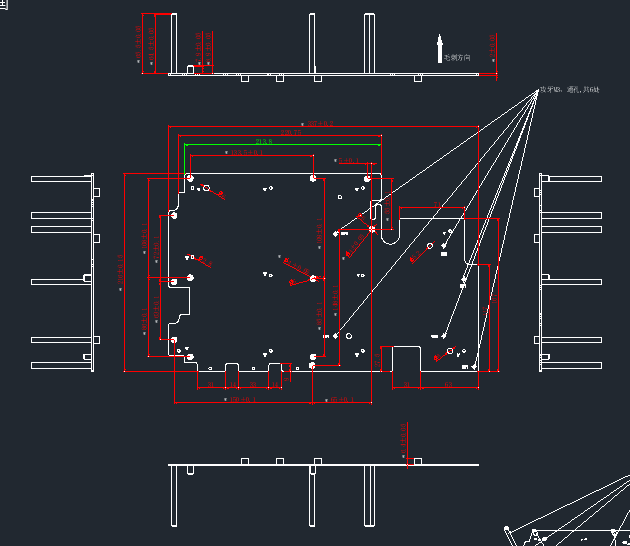
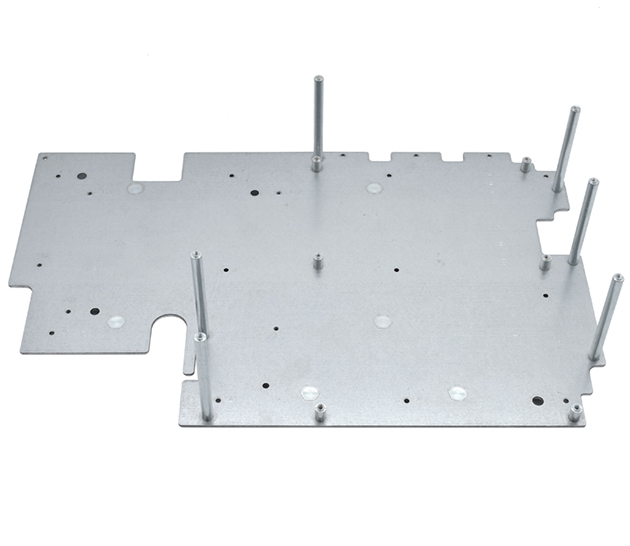
There's a stubborn misconception in consumer electronics manufacturing: structural parts = commodity parts = whoever's cheapest wins.
But any hardware engineer who has lived through a high-end product ramp-up knows better. A PCB mounting bracket is not some interchangeable piece of sheet metal you can source-hop on price alone. It is deeply and irreversibly coupled with your product's drop reliability, signal integrity, EMC compliance, and thermal management. A genuinely precision-engineered bracket delivers value orders of magnitude beyond its raw material worth. A careless one can cost you the entire launch.
This article walks through a real collaboration with a premium Western projector brand — the kind that competes on image quality and reliability, not price — and shows how a precision PCB bracket transformed from an afterthought into the product's last line of defense.
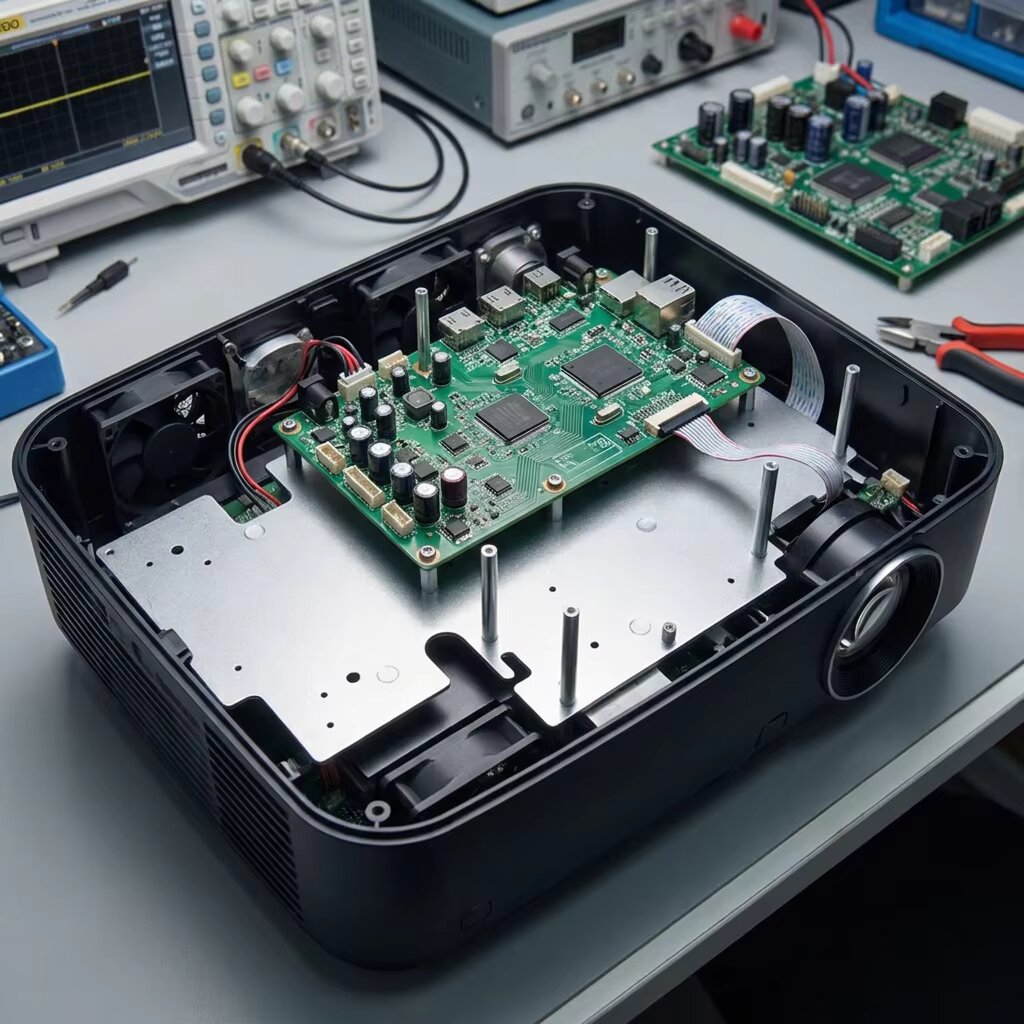
Client C is a boutique projector brand headquartered in California, focused exclusively on the high-end home theater market. Their flagship product: a 4K tri-laser ultra-short-throw projector, retailing at $3,499, with annual volume of approximately 50,000 units. Their brand positioning goes head-to-head with Sony and JVC's premium lines. Their core customers are home theater enthusiasts — the kind who notice a single dead pixel on a 120-inch screen.
Unlike most brands, Client C does not work through ODMs. They run their own supply chain management team and source components directly from a curated global supplier base. Structural parts — sheet metal, die casting, injection molding — are managed directly by the brand's in-house mechanical engineering team.
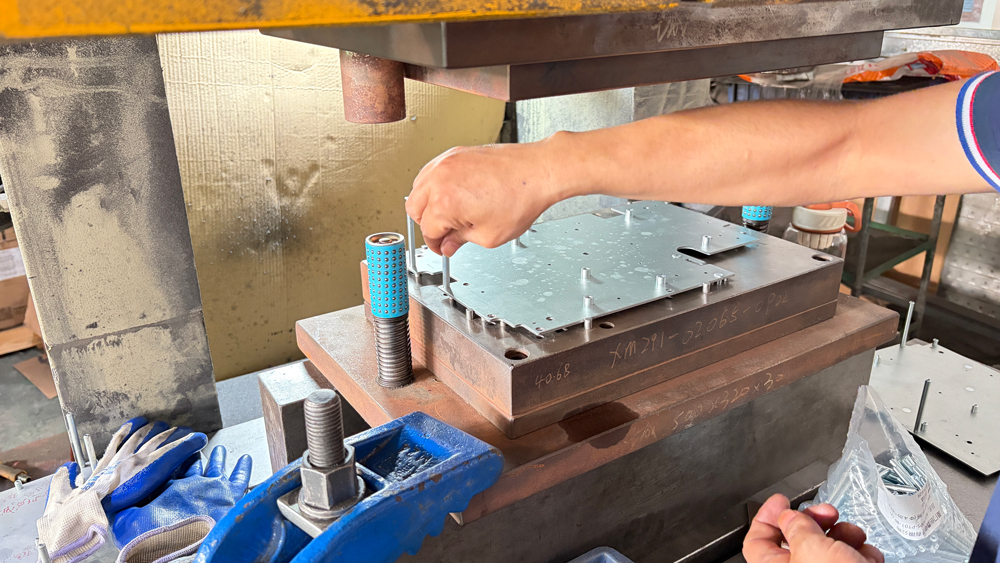
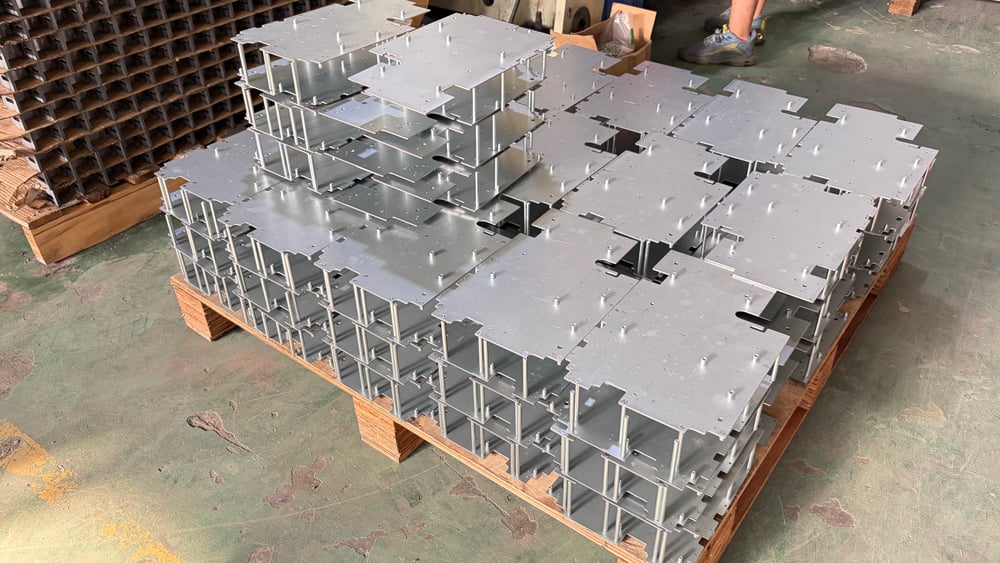
During the final reliability validation run before the new product's mass production launch in late 2023, three critical failures surfaced back-to-back:
Failure #1: Drop test. Under the brand's internal reliability standard — which exceeds FCC and CE regulatory minimums — the unit was subjected to a 1.0m six-face drop test. The DMD driver board shifted 0.35mm relative to the optical engine. For a $3,499 4K projector, this is catastrophic. Micron-level pixel misalignment gets magnified to human-visible artifacts on a 120-inch screen.
Failure #2: HDMI 2.1 signal integrity degradation. During 4K@120Hz full-bandwidth transmission testing, the FPC ribbon cable between the HDMI daughter board and mainboard experienced additional bending stress due to micro-deformation of the bracket. This caused eye-diagram closure in high-frequency bands. The user-facing symptom: "occasional 1-2 second black screens." High-end home theater customers have zero tolerance for any display interruption.
Failure #3: Thermal management failure. With all three laser light sources running at full power, the DMD driver board temperature could reach 78°C. The original bracket mounted the driver board flush against the power supply board with just 2.5mm clearance — a textbook localized heat trap. After 3 hours of continuous operation, the driver board temperature breached 90°C, triggering thermal throttling and a 30% brightness drop.
Failure Domain |
Original Design Performance |
Root Cause |
Positioning accuracy |
DMD board-to-optical-engine relative deviation ±0.2mm |
Single-station die + manual positioning; no unified datum system, no GD&T framework |
Structural rigidity |
0.35mm plastic deformation at 1.0m drop |
SPCC 1.0mm, zero stiffening features; first natural frequency only 52Hz |
Thermal management |
Driver board over-temperature by 15°C |
Bracket layout had zero coordination with thermal design; driven purely by assembly convenience |
Cable routing support |
FPC unsupported span of 38mm; no mid-span support |
Bracket design ignored high-speed FPC bend radius and stress relief requirements entirely |
EMC grounding |
Grounding impedance varied widely across PCBs, peaking at 25mΩ |
No unified grounding network; relied on single-point screw contact |
The client's VP of Engineering was unambiguous: all three issues must have a verifiable fix within three weeks, or the backup supplier evaluation process would be triggered — and the product launch would slip by at least a quarter.
For Client C, this meant:
The initial 5,000 pre-order units at risk of delivery default(order value ~$550K)
The new product launch window potentially lost to competitors ~$300K in upfront tooling and NRE investment at risk of becoming sunk cost
When Client C's supply chain team found us through industry contacts, the original supplier had already attempted two die revisions — neither passed the brand's internal validation. Eighteen days remained.
Upon receiving the client's complete unit, 3D assembly model, and full test reports, we didn't reach for a CAD tool. First, we built a complete assembly FEA model and attacked the problem from three parallel dimensions:
Structural dynamics
1 : Modal and harmonic response analysis of the bracket-optical-engine-PCB assembly. Identified the original bracket's first natural frequency at 52Hz — squarely within the dominant energy band of logistics transport vibration (20-80Hz). This was the physical root cause of drop-test displacement.
Thermal-fluid simulation
2 : Modeled the bracket's impact on internal airflow based on the unit's fan layout and duct design. Confirmed the driver board sat in a dead zone, and the 2.5mm gap to the PSU board created thermal coupling that amplified the problem.
Signal integrity analysis
3 : Modeled the HDMI 2.1 FPC cable's bend radius and support conditions. Confirmed the 38mm unsupported span was the primary cause of high-frequency attenuation — exceeding the recommended design guideline for FPC at 48Gbps data rates.
The conclusion we delivered resonated deeply with Client C's engineering team:
The problem wasn't the bracket material. The entire internal structural layout needed rethinking. If we only changed materials without redesigning the layout, even an unlimited budget would solve at most 40% of the problem. We needed to rethink the bracket's role within the system.
Design Decision |
Specific Solution |
Engineering Rationale |
Material upgrade |
SUS301 stainless steel, 1.5mm thickness |
Yield strength ≥330 MPa; fatigue limit roughly 3× that of SPCC. SUS301 in cold-worked condition (half-hard to full-hard) delivers exceptional anti-relaxation properties without post-process heat treatment — critical for PCB fixation points that must maintain preload force over years of thermal cycling |
Modal optimization |
5 embossed stiffening ribs + 3 hemmed flanges + localized thickened bosses |
Target first natural frequency ≥120Hz. Rib depth and spacing determined through topology optimization; stiffness increased ~190% with only 9% added weight |
Thermal layout redesign |
Driver board independently mounted at primary airflow inlet; PSU clearance expanded from 2.5mm to 14mm |
New dedicated ventilation window in bracket; direct airflow path to driver board backside. Simulation predicted peak driver board temperature drop from 90°C to 68°C |
Integrated cable routing support |
Cable retention slots and curved guide rails integrated into bracket; FPC bend radius ≥8mm |
Stamping + localized edge-rounding process to create smooth cable guiding surfaces directly in sheet metal. FPC fully supported along its entire path — zero unsupported spans |
Unified grounding network |
Through-going beryllium-copper alloy grounding spring contacts; all 5 PCBs to main ground ≤2mΩ |
BeCu spring contacts exhibit far lower stress relaxation under prolonged high-temperature exposure than standard phosphor bronze. Adds $0.12/unit but guarantees first-round EMC pass |
Metric |
Original Design |
Our Design |
Bracket material / thickness |
SPCC 1.0mm |
SUS301 1.5mm |
First natural frequency |
52Hz |
128Hz |
Drop-test DMD board displacement |
0.35mm |
0.03mm |
Driver board operating temperature |
90°C |
67°C |
Grounding network max impedance |
25mΩ |
1.8mΩ |
Bracket unit price |
$1.50 |
$15.80 |
Tooling cost |
$8,000 |
$35,000 |
First-batch production yield |
91% |
99.8% |
The bracket unit price increased 10×. But the new product launched on schedule. All 5,000 pre-order units shipped on time. The brand's reputation in the North American premium projector market remained untarnished.
The bracket's share of total BOM cost rose from 0.04% to 0.45%. For that 0.41% BOM increase, Client C chose a solution that passed every single reliability test on the first attempt. For a company whose brand promise is built on "ultimate image quality and ultimate reliability," the decision required no hesitation.
This case reveals three truths most procurement frameworks overlook:
A $3,499 projector carries a user expectation not of "no problems during the warranty period," but of "maintaining factory-new performance levels for 5-8 years." At this product tier, structural components cannot be designed to "just barely enough." They must have generous engineering margin to absorb the unpredictable stresses, vibrations, and thermal cycling shocks of the real world.
Paying for margin is fundamentally paying for the brand's pricing power insurance.
When a $1.50 bracket fails, the direct cost might be one warranty repair. But for a premium brand, the real cost is a user posting on AVS Forum or Reddit's r/hometheater: "This brand's QC is sketchy." In enthusiast communities, one negative data point influences hundreds of purchase decisions. For a boutique brand that lives and dies by word of mouth, there are no small quality risks — only zero and one.
What determines a bracket's ultimate value is never the market price of steel per kilogram. It's the supplier's engineering capability across these dimensions:
Clients willing to pay for these capabilities are the ones who truly understand manufacturing value. And these clients don't measure your quote in dollars per kilogram.
We are an engineering-driven manufacturer of precision sheet metal structural components for high-end consumer electronics. Our core team comes from the structural engineering and simulation divisions of Tier-1 factories. We don't compete on volume — we build defensibility through engineering depth.
Capability |
Specification |
Material range |
SPCC, SECC, SUS304, SUS301, AL5052, AL6061, copper alloys, BeCu; thickness 0.3-4.0mm |
Simulation capability |
ANSYS structural statics/dynamics, Fluent thermal-fluid, modal & harmonic response, topology optimization |
Stamping precision |
Critical hole diameter / true position ±0.02mm |
Bending precision |
Angular tolerance ±0.2° (CPK ≥ 1.67) |
Surface finishing |
Nickel plating (electroless / electroplated), stainless passivation, anodizing, e-coating, Dacromet, PVD |
Micro-feature processing |
Clinch studs/nuts, in-die tapping (M1.6-M4), precision embossed ribs, BeCu spring contact riveting |
Die capability |
Progressive die, up to 18 stations; die life 2-5 million strokes |
Prototyping lead time |
Laser-cut samples 3-5 working days; soft tooling 7-10 working days; production tooling 15-25 working days |
Production capacity |
2M strokes/month (precision grade); 1M strokes/month (ultra-precision ±0.02mm) |
Quality system |
ISO 9001:2015, IATF 16949 in progress; RoHS/REACH compliant; full dimensional FAI report |
MOQ |
Engineering samples from 5 pcs; mass production from 10,000 pcs |
If you're developing a product with extreme reliability requirements — premium projectors, medical imaging equipment, precision instruments — send us your drawings.
What to include:
1. 3D files (STEP/IGS) with assembly context
2. Reliability testing standards (drop height, vibration spectrum, temperature range, target service life)
3. Current engineering bottlenecks or target performance metrics
We'll respond within 48 hours with a detailed quotation and engineering feasibility assessment. No bureaucratic approval chains. Engineer talks to engineer.

Copyright © 2024 by Xiamen Tongchengjianhui Industry & Trade Co., Ltd. - Privacy policy
