Custom copper busbars built to drawing: laminated flexible links in T2 copper, tin-plated or insulated, hole pitch to ±0.1 mm, first article before series.
You are not shopping a catalogue. You have a panel, a transformer or a battery rack, a terminal layout that will not move, and a drawing that has to come back as a part which fits the first time.
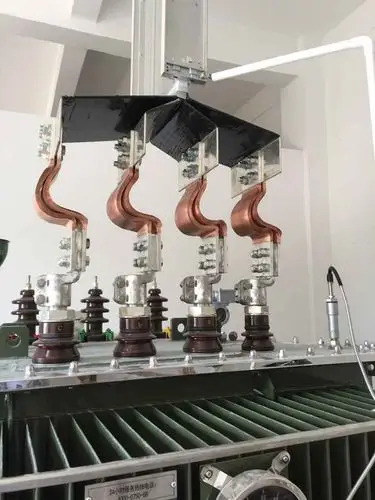
That is the whole job here: one part, customised every way it can be — a flexible copper busbar where the joint has to move, a laminated build where vibration and thermal cycling have to be absorbed, an insulated copper busbar where the environment demands it. T2 copper, tin-plated, drilled and formed to your drawing, marked and packed for your line. We build for panel builders, transformer OEMs, energy storage integrators and contract manufacturers who order the same part again next quarter — which is a different business from selling a bar off a shelf.
A custom copper busbar is defined by the drawing, not by a stock list. Plenty of suppliers say custom and mean "we stock forty sizes". These are the parameters that actually change between one order and the next.
If a dimension is missing from the drawing, we ask instead of assuming. A 2 mm assumption on hole pitch is the difference between a part that drops in and a shipment that comes back.
The drawing tells us the shape. These tell us whether the shape is right:
Send those six with the drawing and the quotation comes back usable. Send only the drawing and we will come back with questions, which costs both sides a week.
For a custom part, the section is a design decision, not an order option. Most copper busbar manufacturers quote a bar size and leave the thermal question with you; we would rather answer it, without expecting you to take our word for it or expecting to take yours.
The working baseline for bare copper in still air is about 1,000 A per square inch — 1.55 A per mm² — at a 30 K temperature rise. From there it is all derating.
Derate 15–30% for a sealed enclosure, ambient above 40 °C, flat rather than edge mounting, or parallel bars closer than one bar thickness; add about 10% above 2,000 m altitude. Two bars in parallel never simply double the rating, because spacing decides how much heat each bar can shed.
Where the copper busbar sizes on your drawing look marginal against the current carrying capacity required, we say so before quoting, and the assumption we used goes on the quotation in writing — so when the panel is type-tested two years later, the number is still traceable.
Copper busbar fabrication runs through eight steps, and each one has a failure mode that shows up months later if it is skipped.
A drawing with no tolerances gets our standard, and our standard may not be yours. If a dimension is functional — a hole pitch that must line up with a bushing pattern, a bend that has to clear a partition — mark it.
Angle on a multi-plane part is worth a separate note on the drawing; two bends in different planes interact, and the second one moves the first.
Copper. T2 / C11000 as standard, Cu ≥ 99.90%, conductivity ≥ 98% IACS. T1 and oxygen-free copper are available where the joint will be welded or the part runs hot.
Plating. Tin at 3–8 µm is the default for copper-to-copper bolted joints — it blocks oxide growth, keeps contact resistance stable and holds torque over thermal cycling. Silver at 2–5 µm where the panel design calls for it or the joint runs hot. Nickel for wear and chemical resistance. Masked areas are left bare when you need to weld or bond.
Insulation. An insulated copper busbar is the bare part plus a sleeve: PVC heat-shrink at 1 kV for LV panel interiors; PET where you want better mechanical and temperature performance at the same wall; silicone where the bend moves or the temperature is high; 3 kV grade where phase spacing is tight. Partial sleeving is normal — cover the live run, leave the pads bare, keep the creepage at each end.
Two things we will push back on: a bend radius tighter than the stack thickness, and a hole whose edge sits inside the bend zone. Both can be made. Neither survives a few hundred thermal cycles.
Not every order needs all of these, but all of them can be supplied:
Custom parts fail in transit as often as in production. Plated ends are packed with board separators or bubble sleeves so they cannot rub; sleeved parts never sit against a sharp edge; matched pole sets stay together and are labelled in the sequence your line assembles them.
For project shipments we can kit per panel, mark cartons with your part number and panel reference, and ship on fumigation-free pallets. Bare copper bar is usually declared under HSN 7407.10; insulated or assembled flexible links may fall under another subheading, and we ship against the code your broker confirms.
What is your MOQ for a custom copper busbar? Fifty pieces is typical for a first order, because the fixture and weld program have to be amortised. Below that we will still quote, but the unit price reflects a one-off setup rather than a series part.
Can you copy a part we already buy? Yes, and it is often the fastest route. Send the drawing, or a physical sample with the critical dimensions marked. We will tell you where the existing part is over- or under-specified before we quote.
Will you sign an NDA? Yes. Drawings are used for quotation and production only and are not shared with third parties or used for other customers.
How long does a sample take? Typically about a week after drawing approval, longer if new plating or sleeving tooling is involved. The quotation carries the date we are committing to.
What if I do not know the right section? Send the load, the ambient temperature and the panel type. We will propose a section, state the assumption, and mark it on the drawing so it can be reviewed by whoever signs off the design.
Can you hold hole pitch for a retrofit onto an existing bushing pattern? That is the normal case. Send the measured pattern as well as the drawing — on retrofits the measured pattern wins, and ±0.1 mm cumulative is achievable if we work from the measurement rather than the nominal.
Do you supply the bolts, insulators and supports? Copper busbars are supplied drilled to your fastener size. Stand-off insulators, bolts, washers and supports can be quoted as a kit if you would rather receive one line item per panel.

Copyright © 2024 by Xiamen Tongchengjianhui Industry & Trade Co., Ltd. - Privacy policy